

Table of Contents
- Why Luxury Clip Ins for Natural Hair Are Worth the Investment
- What Makes Clip Ins Truly Luxury: Quality Standards to Check
- The Best Human Hair Clip Ins for 4C Hair: Texture Matching Guide
- How to Blend Clip Ins With Natural Hair
- How Long Do Clip In Extensions Last? Maintenance and Longevity
- Scalp Health, Tension Management, and Ethical Sourcing
- Cost Per Wear: The Real Value of Luxury Clip Ins
- Frequently Asked Questions
Last Updated: September 12, 2026
Why Luxury Clip Ins for Natural Hair Are Worth the Investment
Most clip-ins were never designed for Type 4 coils: they slip, tangle at the seam, and leave your leave-out looking like an afterthought. Luxury clip ins for natural hair solve that by matching cuticle direction, curl pattern, and density to your texture, so the wefts disappear into your hair instead of sitting on top of it.
This guide from Kinkistry breaks down what separates premium clip-ins from merely expensive ones and how to match them to natural hair.
The difference shows up fast: a cuticle-aligned weft moves with your hair, while a silicone-coated one sits stiff and mats within weeks.
What Makes Clip Ins Truly Luxury: Quality Standards to Check
Luxury clip-ins are defined by four things: 100% Virgin human hair, cuticle-aligned strands, seamless wefts, and clips that grip without pulling. Miss one and you are paying premium prices for a mid-tier product.
Here is what to verify before you buy:
- Hair origin and type. Virgin human hair keeps cuticles intact and running one direction, so it stays tangle-free. Synthetic and non-Virgin hair sheds and frizzes.
- Weft construction. Seamless wefts lie flat; bulky, folded wefts create visible bumps under fine hair.
- Clip quality. Silicone-coated clips hold tension without snagging; bare metal clips slip and tug.
- Double-drawn density. Double-drawn bundles keep consistent thickness root to tip, so ends do not thin out.
- Heat tolerance. Professional-grade human hair handles heat styling, confirm heat-resistant status before you reach for a flat iron.
Standard |
What to Look For |
Why It Matters |
|---|---|---|
Hair type |
100% Virgin human hair |
Tangle-free, reusable |
Cuticle |
Aligned, intact |
Holds curl pattern |
Weft |
Seamless |
Lies flat, invisible |
Clips |
Silicone-coated |
No slipping or snagging |
Density |
Double-drawn |
Even thickness to ends |
A common mistake is buying on texture match alone. A weft can match your curl pattern perfectly and still fail if the cuticles are stripped.
The Best Human Hair Clip Ins for 4C Hair: Texture Matching Guide
The best human hair clip ins for 4C hair match curl pattern, porosity, and density, not just color. Type 4C coils are the tightest, most fragile pattern, so a mismatched weft either sits visibly on top of your hair or pulls at your own strands (peer-reviewed research).
Texture matching starts with honest self-assessment:
- Curl pattern. 4C hair forms a tight Z-shaped coil with minimal definition. Look for extensions labeled coily or kinky, not "curly."
- Porosity. Low-porosity 4C hair repels moisture; high-porosity absorbs and loses it fast. Extensions should behave similarly so they age at the same rate.
- Density. Fine 4C hair needs lighter wefts; thick, dense hair can carry heavier bundles without tension.
If you are unsure where you fall, Kinkistry offers expert guidance to find your match rather than guessing. Getting this wrong is the number one reason people abandon clip-ins after one wear.
How to Blend Clip Ins With Natural Hair
Blending clip ins with natural hair comes down to three moves: sectioning cleanly, backcombing (if needed) at the root, and leaving out just enough hair to cover the weft. Most people leave out too much, exposing the clips, or too little, leaving the weft visible. With 4C coils there is a fourth variable competitors ignore: shrinkage. A leave-out that looks long enough when stretched can snap back two to three inches shorter than the weft once dry, which is why so many 4C wearers see the seam reappear an hour after styling.
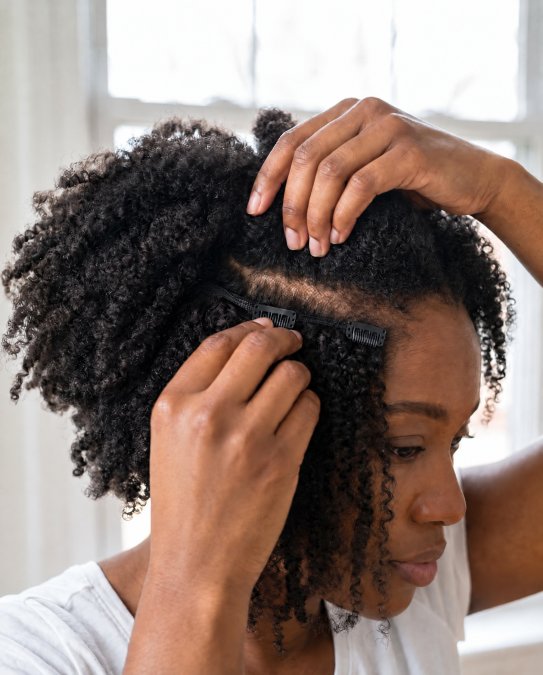
Step-by-step guide for blending luxury clip ins into coily natural hair for a seamless, undetectable finish
A workable sequence for 4 type textures:
- Start on freshly stretched or blown-out hair. Clipping into shrunken 4C hair is the most common blending failure, its difficult for the weft to lie flat against a coil already recoiling.
- Part horizontally about an inch above the nape, in sections no wider than the weft.
- Backcomb the root lightly for grip (if needed). On fine 4C hair, use fewer strokes, over-teasing weakens the strands the clips will grip.
- Clip the weft in, pressing until it seats. If you feel a pinch, the clip is too tight; reposition rather than tolerate it.
- Release the hair above and blend with fingers preferably, not a brush, brushing pulls the coil pattern apart and frizzes the seam.
- Repeat upward, leaving a thin layer of your own hair over the top weft. On 4C hair, that leave-out should be at least an inch wide so it covers the weft after shrinkage.
For a blowout finish, use low heat, jeat protectant and a light hold spray. For a coily look, refresh with a leave-in conditioner moisture mist and finger-coil the leave-out to match the weft.
Tension matters as much as blending. Never place clip-ins directly on your hairline or edges, leave at least an inch of margin, and rotate placement every wear so the same strands are not stressed repeatedly (the American Academy of Dermatology). If you feel a headache or sore spots by mid-day, the wefts are too heavy for your density or the clips are seated too tight.
The real test is movement: shake your head. If a clip shifts, it is not seated properly.
How Long Do Clip In Extensions Last? Maintenance and Longevity
Clip in extensions can last up to a year or more with proper care, depending on hair quality and wear frequency. Virgin human hair with aligned cuticles outlasts non-Virgin and synthetic options by a wide margin because it resists the matting that forces early replacement. The variable most guides leave out is moisture balance: 4 type hair and 4 type-matched wefts both need moisture, but over-moisturizing a weft swells the cuticle and loosens the seam. The goal is parity, extensions should age at roughly the same rate as your natural hair.
Your maintenance routine decides most of it:
- Wash every 6 to 8 wears, not every wear. Over-washing strips moisture; under-washing builds product up at the seam.
- Use sulfate-free shampoo and a moisture-focused conditioner, sulfates lift the cuticle, the opposite of what aligned Virgin hair needs.
- Detangle from the ends up with a wide-tooth comb while damp, working upward in small sections, never pull from the root.
- Air-dry on a towel, never wring or brush wet wefts. Wet hair is most fragile and the seam is the weakest point.
- Store flat in a satin bag or on a hanger. Folded wefts develop permanent bends at the fold line.
- Deep-condition every 3rd wash with a lightweight mask. Heavy butters for natural hair can weigh down wefts and separate them from your coils.
Shedding prevention comes down to two habits: never brush at the seam, and never sleep in your clip-ins. Both stress the weft and loosen the clips. Shedding starts at the seam and cannot be reversed once the weft structure loosens, so the first sign of matting is the moment to change your routine, not buy a replacement.
Cost Per Wear: Why Longevity Is the Real Luxury Metric
Lifespan is only half the story. The number that justifies a luxury price is cost per wear, and it almost always favors cuticle-aligned Virgin hair.
Scalp Health, Tension Management, and Ethical Sourcing
A luxury clip-in should never hurt. Tension headaches, sore spots, and traction at the hairline mean the clips are too tight, too heavy, or placed too close to your edges (PubMed).
Protect your scalp with three rules:
- Never clip directly on your hairline. Leave at least an inch of margin.
- Limit wear time. Take clip-ins out before bed and give your scalp a break daily.
- Rotate placement. Clipping in the same spot daily weakens the strands underneath.
Kinkistry is a Black-owned business built specifically for textured hair, so wefts are designed around Type 4 coils rather than adapted from straight-hair templates, a choice that shows up in scalp comfort as much as blending.
Cost Per Wear: The Real Value of Luxury Clip Ins
Here is how to run the math on any set:
Cost per wear = purchase price ÷ (wears per month × months of usable life)
A set worn twice a week for twelve months gives you roughly 100 wears. A set that lasts two months gives you around 16. The second set has to be replaced six times to match the first, and each replacement carries the same installation learning curve and blending frustration.
Factor |
Budget Clip-Ins |
Luxury Clip-Ins |
|---|---|---|
Hair type |
Often non-Virgin or synthetic blend |
100% Virgin human hair |
Typical lifespan |
A few months |
A year+ |
Tangling |
Frequent at the seam |
Minimal with care |
Reusability |
Low |
High |
Cost per wear |
Rises fast with replacement |
Falls with every wear |
If you are weighing a switch from another brand, the question to ask is not "is this cheaper?" but "how many wears will I actually get?"
Finding clip-ins that match 4 type coils, stay comfortable against your scalp, and hold up past the first wash is harder than it should be. Kinkistry builds extensions and wigs specifically for textured hair, backed by expert guidance to match your curl pattern and porosity, plus the HydraLuxe hair care line for moisture-focused maintenance. With more than 30,000 customers and a military discount for those who serve, Kinkistry makes it straightforward to get a camera-ready look without compromising your natural hair. Add to Bag and find your texture match.
Frequently Asked Questions
How do I know if luxury clip ins will blend with my specific curl pattern?
Luxury clip ins are designed to match a range of curl patterns, from loose waves to tight coils. Start by identifying your curl type (3A-3C, 4A-4C) and look for brands that offer texture-specific options. Kinkistry, for example, provides clip-ins in various coil patterns and offers guidance to help you find the right match. If you're unsure, many brands offer curl pattern quizzes or customer support to assist. Proper blending also depends on how you install and style them, so take time to section your hair and use a little product to merge the textures.
How long do high-quality clip in extensions last with regular wear?
With proper care, high-quality human hair clip ins can last twelve months or longer. Longevity depends on how often you wear them, how you store them, and your maintenance routine. Wash them with sulfate-free shampoo, deep condition regularly, and always use heat protectant before heat styling. Avoid sleeping in them and store them on a hanger or in a silk bag to prevent tangling. Luxury options maintain their integrity with consistent care.
Can I use luxury clip ins on fine or loosely coiled natural hair?
Yes, luxury clip ins can work for fine or loosely coiled hair if you choose the right texture and weight. Look for lightweight wefts and clip-ins that match your natural pattern, such as a wavy or curly texture. Blending is key: use a leave-in conditioner or curl cream to help your natural hair and the extensions merge. Avoid heavy wefts that can weigh down fine hair. Some brands, like Kinkistry, offer options for a range of textures, so you can find a match even if your hair isn't tightly coiled.
Are luxury clip ins worth the higher price compared to cheaper alternatives?
Luxury clip ins often use 100% Virgin human hair with cuticles aligned, which reduces tangling and shedding. They also offer better color matching, more texture options, and longer lifespan. When you calculate cost per wear, luxury clip ins can be more economical over time. Additionally, many luxury brands provide educational resources and customer support to ensure you get the right fit, which adds value beyond the product itself.